In the future, fusion energy is expected to provide clean, safe, and resource-efficient electricity regardless of weather conditions. There is still a long way to go, but the race to build the first fusion power plant is in full swing. The German government has set itself the goal of building the world’s first fusion power plant in Germany. To this end, the German government has adopted an action plan at its cabinet meeting.
Fusion is not a short-term solution, but an investment in the energy supply of the future. Energy-intensive processes such as hydrogen production could also benefit from fusion power plants in the future.
Over two billion euros for fusion research
The Fusion Action Plan implements an important measure of the High-Tech Agenda Germany (HTAD). This stipulates that the Fusion Action Plan must be presented by the end of 2025. This has now been done. The Fusion Action Plan is a commitment by the German government to fusion research with the clear intention of realizing a fusion power plant in Germany. An industry-led consortium of primarily German companies is to build the power plant. It should consist of start-ups, established companies from industry, and players from the scientific community.
In order to achieve the goal of a first fusion power plant in Germany, more than two billion euros are to be invested in fusion research by 2029 alone: for research funding and to support the development of new research infrastructures and technology demonstrators. Research infrastructures are used for basic research, while demonstrators are used to test relevant technologies for continuous operation.
According to the German government, nuclear fusion could “become an important part of our electricity supply in the future.” However, fusion is not a short-term solution. “There are still considerable technological challenges to overcome on the way to the first fusion power plant.”
Fusion companies in Germany
While existing nuclear power plants split atoms to generate energy, fusion does the opposite: two atoms are combined, releasing large amounts of energy. This energy can be dissipated as heat to generate steam, as in a coal-fired power plant, and drive a turbine and generator.
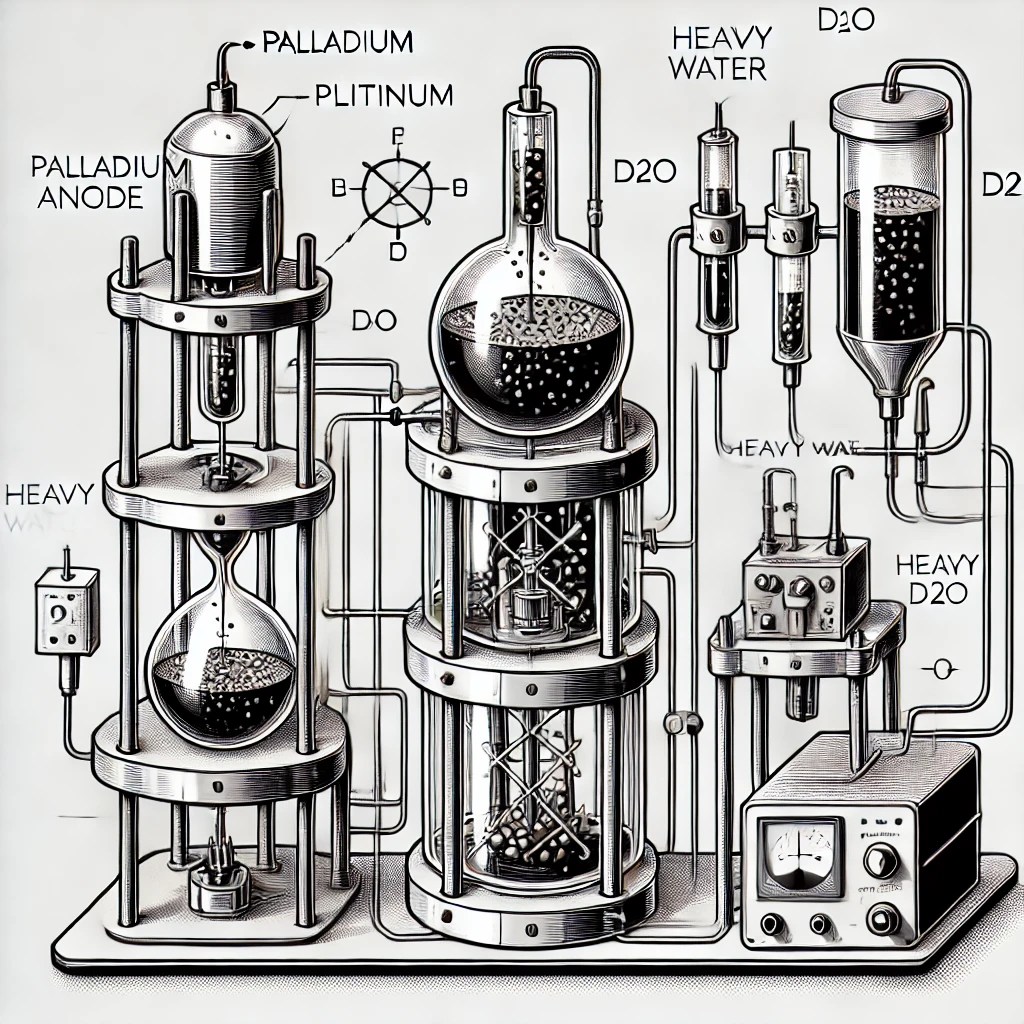
Beside Impossible Fusion which favors LENR as fusion pinciple, four start-ups in Germany have set out to solve these problems in recent years. They want to bring two different technologies to market maturity: magnetic fusion ( Gauss Fusion , Proxima Fusion) and laser fusion ( Focused Energy , Marvel Fusion).
The energy company RWE announced on Thursday that it would invest ten million euros in the Darmstadt-based start-up Focused Energy. Depending on how the project progresses, the company says it could envisage expanding its involvement in the future.
A few days ago, the young companies had already made their voices heard with a position paper: “Without decisive action in this legislative period, Germany and Europe are in danger of falling behind again,” they write. “The US and China are striving to take over market leadership before the beginning of the 2030s with investments worth billions and initial demonstrators.”
Three billion euros are now needed by the end of the legislative period “for the successful kick-off of the German fusion industry.” It will probably be a little less money now. Nevertheless, the industry is pleased. The action plan sends an important signal, according to Munich-based start-up Proxima Fusion. Germany is positioning itself as the European driver for the ramp-up of this technology.
The Fraunhofer Society is also positive: “With its excellent expertise in research and technology, our country is ideally positioned to make CO2-neutral energy generation through fusion a reality,” comments Holger Hanselka, President of the Fraunhofer Society. For science and industry, the government’s action plan is a strong signal that Germany is seizing this opportunity.
Planning the first running reactor
However, Francesco Sciortino, CEO of Proxima Fusion, also urges that the funds be used wisely. “It is crucial that the funds be invested specifically in technology transfer, particularly in the construction of a fusion demonstrator.” Proxima Fusion is planning just such a demonstration reactor by 2031.
The start-up is building on research results from the Wendelstein 7-X experimental facility in Greifswald, where its leading employees have been involved in research. The so-called stellarator (a device for the magnetic confinement of hot fusion plasma) is considered the most sophisticated facility of its kind in the world, and the technology behind it is seen as a promising new variant of nuclear fusion.
Germany has a leading position in stellarator technology, says Proxima Fusion CEO Sciortino. This should now be rapidly expanded with funding from Berlin. “Germany cannot afford a second Transrapid in fusion – a world-class technology that never made it to market.”
The Fraunhofer Society, on the other hand, wants to promote competing laser fusion and is calling for the creation of “technology hubs” “to effectively bring together research and industry, scale applications, and secure a leading role in laser fusion.”
The role of the state as an anchor customer that specifically promotes cooperation between research institutions and industry is crucial in this regard. High-risk projects that involve high development costs should also be supported by the state in order to facilitate private investment.
The Munich-based start-up Marvel Fusion is also working on laser fusion. “Germany is positioning itself at the forefront of fusion energy,” says Marvel Fusion COO Heike Freund. “What is still needed on the way to a power plant are targeted funding instruments that leverage more private capital.” Milestone-based funding programs, for example, are seen as a promising approach. “The leverage effect of government support for private investment should not be underestimated,” says Freund.
The Munich-based company is also pleased with Berlin’s decision not to regulate fusion under the Atomic Energy Act, but to continue to do so under the Radiation Protection Act. Start-ups had feared that this would create hurdles for the development of their industrial projects.
“A separate, sustainable legal framework for fusion energy, separate from nuclear safety law, is absolutely essential,” said Günter Kraft, head of communications and policy at the Darmstadt-based start-up Focused Energy, a few days ago.
More complex than the Webb telescop
The competition never sleeps: at the end of August, for example, US start-up Commonwealth Fusion Systems completed a financing round worth $863 million and signed an agreement with Italian energy group ENI to supply energy worth $1 billion. The start-up aims to commission its first fusion reactor as early as the beginning of the 2030s.
This is a schedule that leading researchers consider extremely ambitious, if not unrealistic. “I think it’s realistic that a first fusion reactor will generate more energy than it consumes in 20 to 25 years,” Christian Linsmeier, director of the Institute of Fusion Energy and Nuclear Waste Management at the Jülich Research Center, told WirtschaftsWoche magazine in the spring. “However, this first reactor would not yet be a power plant that can supply electricity 24 hours a day from day one.”
In magnetic fusion, reactors must generate plasma at a temperature of 100 million degrees Celsius and keep it stable in a magnetic field. In laser fusion, a fuel pellet the size of a peppercorn must be imploded several times per second.
Temperatures hotter than the sun, cooling colder than many places in the universe, plus neutron bombardment that can wear down the reactor walls – the challenges for control technology, construction, and fundamental physics are immense. Supercomputers take weeks or months to simulate the conditions in plasma. Even founders refer to it as probably “the most complex machine in the world.”
How quickly fusion will come – and whether the electricity it produces will be competitive at all and fit into the future energy system – remains to be seen. Used correctly, the €2.5 billion will bring us a step closer to the answer.
 Impossible Fusion